 |
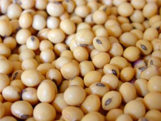
The major U.S.
oilseed crops are soybeans, cottonseed, canola, rapeseed, sunflower seed,
and peanuts. Soybeans are the dominant oilseed in the United States,
accounting for about 90 percent of U.S. oilseed production. Most U.S.
soybeans are planted in May and early June and harvested in late
September and October; see Usual Planting and Harvesting Dates for U.S.
Field Crops for soybean dates by region. |
U.S. soybean
plantings peaked at 75.1 million acres in 2004, a 30-percent increase
since 1990. Increased planting flexibility, steadily rising yield
improvements from narrow-rowed seeding practices, a greater number of
50-50 corn-soybean rotations, and low production costs (partly due to
widespread adoption of herbicide-tolerant varieties) favored expansion
of soybean acreage in the 1990s. More than 80 percent of U.S. soybean
acreage is concentrated in the upper Midwest, although significant
amounts are still planted in the historically important areas of the
Delta and Southeast. Acreage tends to be concentrated where soybean
yields are highest.
Rising yields have
also encouraged expansion of soybean acreage, as new seed varieties,
fertilizer and pesticide applications, and management practices have
improved over time. Higher yields reduce per-bushel production costs,
which enhances profitability. ERS data indicate that soybean production
costs and returns for each region vary from the national average.
Midwestern soybean producers generally have higher yields and lower
per-acre cash costs than Southern and Eastern producers.
Data from the 2002
Census of Agriculture indicated that 317,611 U.S. farms raised soybeans
in 2002, down from 511,000 in 1982. With more acreage and fewer farms,
harvested soybean acreage per farm increased from 114 acres in 1978 to
228 acres in 2002. Although small farms with less than 250 acres
accounted for 72 percent of the farms growing soybeans, these farms
produced only 26 percent of the 2002 crop. Irrigation was used on 5.5
million acres of soybeans, or 7.5 percent of total 2002 acreage.
Individual or family farms accounted for 85 percent of all soybean farms
in 2002 and 73 percent of soybean production. The remainder were largely
partnerships and small family-held corporations, with other corporations
accounting for less than 1 percent of soybean farms and soybean
production.
In the United
States, soybeans are most commonly grown in a crop rotation with corn.
As soybean acreage in the South has declined since the early 1980s,
there is less double cropping of soybeans with winter wheat. In recent
years, an increasing number of soybean farmers have adopted conservation
tillage practices. With less intensive soil cultivation, weed control
depends more heavily on herbicide applications. Soybean pesticide use
(nearly all of which are herbicides) ranks second only to corn.
Commercial fertilizer was applied to less than 40 percent of soybean
acreage, a much lower rate than for most row crops (e.g., corn and
cotton). Unlike other crops, soybeans can fix their own nitrogen and
require minimal nitrogen fertilizer.
Soybeans were one of
the first bioengineered crops to achieve commercial success. USDA now
conducts a farm survey to determine the extent of the adoption of
biotech crops. The data indicate that soybeans comprise the greatest
number of U.S. biotech crop acres.
The popularity of
bioengineered soybeans among U.S. farmers has ramifications for resource
use, marketing, and international trade. Herbicide-tolerant soybeans
have changed the amount and type of herbicides used by farmers. In
response to consumer preferences, both domestic and foreign, grain
handlers are assessing the value of segregating bioengineered soybeans
from conventional varieties. The added cost for segregating nonbiotech
corn and soybeans could be higher than for segregating value-enhanced
crops. Differentiating biotech and nonbiotech commodities may become an
issue for grain handlers. Initially, the bioengineering of oilseed crop
traits has focused on improving production attributes, such as higher
yields and lower costs. But enhanced functionality characteristics will
soon emerge.
In the United States, nearly all soybeans are crushed to extract the oil from the
resulting meal. A comparatively small amount of whole
soybeans are used for seed, roasted for snacks or on-farm dairy
feed, and consumed as traditional soyfoods such as tofu. Almost all
soybean crushers are located near the major production regions, with
good access to rail and barge carriers that transport products to Gulf
of Mexico ports. For crushers, the soybean processing decision involves
choosing when to commit to buying soybeans (e.g., from farmers), to
processing them, and to selling soybean meal and oil (e.g., to food and
feed manufacturers). The main decision variable in making binding
commitments on future dates to sellers and buyers is the gross soybean
processing margin. This margin equals the per-bushel revenue of soybeans
processed into oil and meal minus the per-bushel soybean price. If the
gross soybean-processing margin is high enough, a processor will commit
soybean-processing resources for that date. If it is too low, the
processor keeps the processing resources available for a future date and
a higher margin.
Soybean meal is the
most valuable component obtained from processing the soybean, ranging
from 50-75 percent of its value (depending on relative prices of soybean
oil and meal). By far, soybean meal is the world's most important
protein feed, accounting for nearly 65 percent of world supplies.
Livestock feeds account for 98 percent of soybean meal consumption, with
the remainder used in human foods such as bakery ingredients and meat
substitutes.
Soybean oil
generally has a smaller contribution to soybean value, as it constitutes
just 18-19 percent of the soybean's weight. Yet soybean oil accounts for
about two-thirds of all the vegetable oils and animal fats consumed in
the United States. It is mainly used in salad and cooking oil, bakery
shortening, and margarine, as well as in a number of industrial
applications. Worldwide, soybean oil is still the largest source of
vegetable oil. However, the rapid growth in palm-oil output means it
will likely surpass soybean oil's top ranking within a few years.
Soybean Futures
Information
Soybean Futures
Contract Size
5,000 bushels
Deliverable
Grades
No. 2 Yellow at par,
No. 1 yellow at 6 cents per bushel over contract price and No. 3 yellow
at 6 cents per bushel under contract price*
*No. 3 Yellow
Soybeans are only deliverable when all factors equal U.S. No. 2 or
better except foreign material.
Tick Size
1/4 cent/bu
($12.50/contract)
Price Quote
Cents bushel
Soybean Futures
Contract Months Sep, Nov, Jan,
Mar, May, Jul, Aug
Soybean Futures
Last Trading Day The business
day prior to the 15th calendar day of the contract month.
Soybean Futures
Last Delivery Day Second
business day following the last trading day of the delivery month.
Soybean Futures
Trading Hours Open Auction:
9:30 a.m. - 1:15 p.m. Central Time, Mon-Fri.
Electronic: 6:31 p.m. - 6:00 a.m. and 9:30 a.m. - 1:15 p.m. Central
Time, Sun.-Fri.
Trading in expiring contracts closes at noon on the last trading day.
Soybean Futures
Ticker Symbols Open Auction:
S Electronic: ZS
Soybean Futures
Daily Price Limit 50 cents/bu
($2,500/contract) above or below the previous day's settlement price. No
limit in the spot month (limits are lifted beginning on First Position
Day |